Struggling with vulnerability
What the Domestic Ghosts project has taught me.
As a portrait photographer working in Exmouth, Devon, my project Domestic Ghosts has pushed me into territory I didn’t expect: photographing men not in their armour, but in their uncertainty.
And to be blunt, I’m not happy with the portraits I’ve made so far.
This image of Max is a classic example of a vulnerable portrait still inhabiting a position of strength. It is a nice portrait, but it is not a Domestic Ghost.
Not because the men I’ve photographed weren’t willing to be vulnerable, but because I wasn’t willing to be vulnerable enough myself.
I know how to make a man look solid.
I know how to make a strong black-and-white portrait.
I know how to photograph the mask.
What I don’t yet do well enough is photograph the quiet battles men face in private. The ones that speak to men’s mental health in Exmouth and beyond. The images that matter.
And that’s the truth I want to talk about.
Why the vulnerable portraits aren’t there yet.
Every man I’ve photographed so far has chosen a place in nature; the estuary, the beach, the cliffs, somewhere he feels able to drop his guard. But even in wide open spaces there’s tension. Men know how to perform strength even when they’re alone.
And I’ve realised I’ve been too cautious to push past that performance.
I’ve been afraid of asking the deeper questions.
Afraid of going further into their emotional terrain.
Afraid of getting it wrong, of going too far.
But underneath all of that, the real fear has been simpler: being seen as soft.
I come from a military world where softness is read as weakness, where emotional exposure doesn’t fit the model of masculinity you’re taught to perform. I’ve spent years learning how to keep that side of myself hidden, controlled, quiet. That conditioning doesn’t disappear just because you pick up a camera.
So I told myself the problem was technical. Lighting. Consistency. Location. Something I could adjust without exposing myself.
But the truth is this: you can’t ask another man to step into vulnerability while you stay safely outside it.
The “vulnerable” images I’ve made so far have mostly shown men wearing another version of strength.
The creative vulnerability behind the camera
Working on this series has exposed how much I still hold myself back creatively. Photographing vulnerability and practising vulnerability turn out to be the same muscle; and mine is underdeveloped.
I haven’t been giving these men space to soften. To let their breathing change. To let their posture collapse. I haven’t challenged them to sit with their own vulnerability because I’ve been afraid of feeling stupid, embarrassed, or unmanly myself.
But discomfort is where the real portraits live. In his discomfort and in mine.
If the images haven’t worked yet, it’s because I’ve been photographing from the shoreline, unwilling to step into the water with them.
Where the project goes from here
This project has forced me to confront parts of myself I’ve spent years avoiding. My fear of being mocked for being creative. My fear of being seen as soft. My instinct, shaped by military masculinity, to keep emotional language buried.
Even writing this, I feel that resistance.
But the clarity that’s come from this work is simple.
I need to be braver.
I need to ask harder questions.
I need to help my subjects enter an emotional space, and stay there long enough for something true to happen.
If I want real vulnerability in this work, I have to go first.
And maybe that’s the actual ghost this project is exhuming: not the fragile parts of other men, but the parts of me I’ve kept guarded for years. A creativity kept quiet. An emotional language trodden down, now insisting on being heard.
I’ve already started to change my approach.
My latest portrait session was with Dixie, a former Royal Marine. A veteran. A man who, fifteen years after leaving service, still wears a mask and still performs a role society expects of him. But now Dixie is training as a method actor, a far-flung corner from his previous life.
We worked in a local theatre, using the stage as a metaphor for the character he performs, and the wings — hidden behind the curtain — as an exploration of his emotional, vulnerable landscape.
This time, once the camera was set, I stepped away from it. I left it on a tripod and stood back. I wrote a series of ten questions, designed not to be answered out loud, but to be felt internally. Questions intended to make him uncomfortable.
Those questions changed his posture. His breathing. His expression.
And those changes are what I photographed.
The results feel closer to the project I originally envisioned. Closer to something honest. They feel more like ghosts than statues.
And I’m far more content with that.
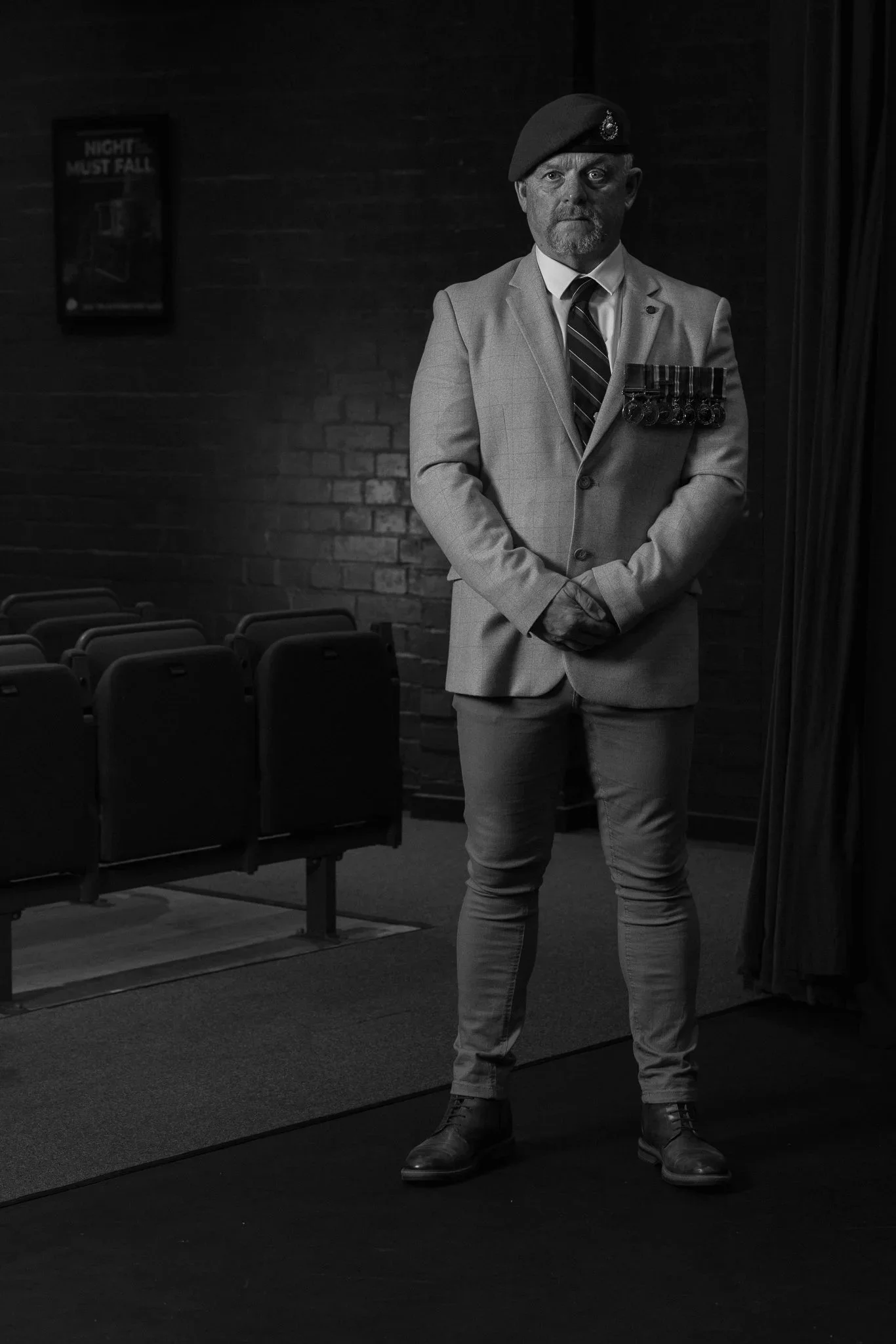
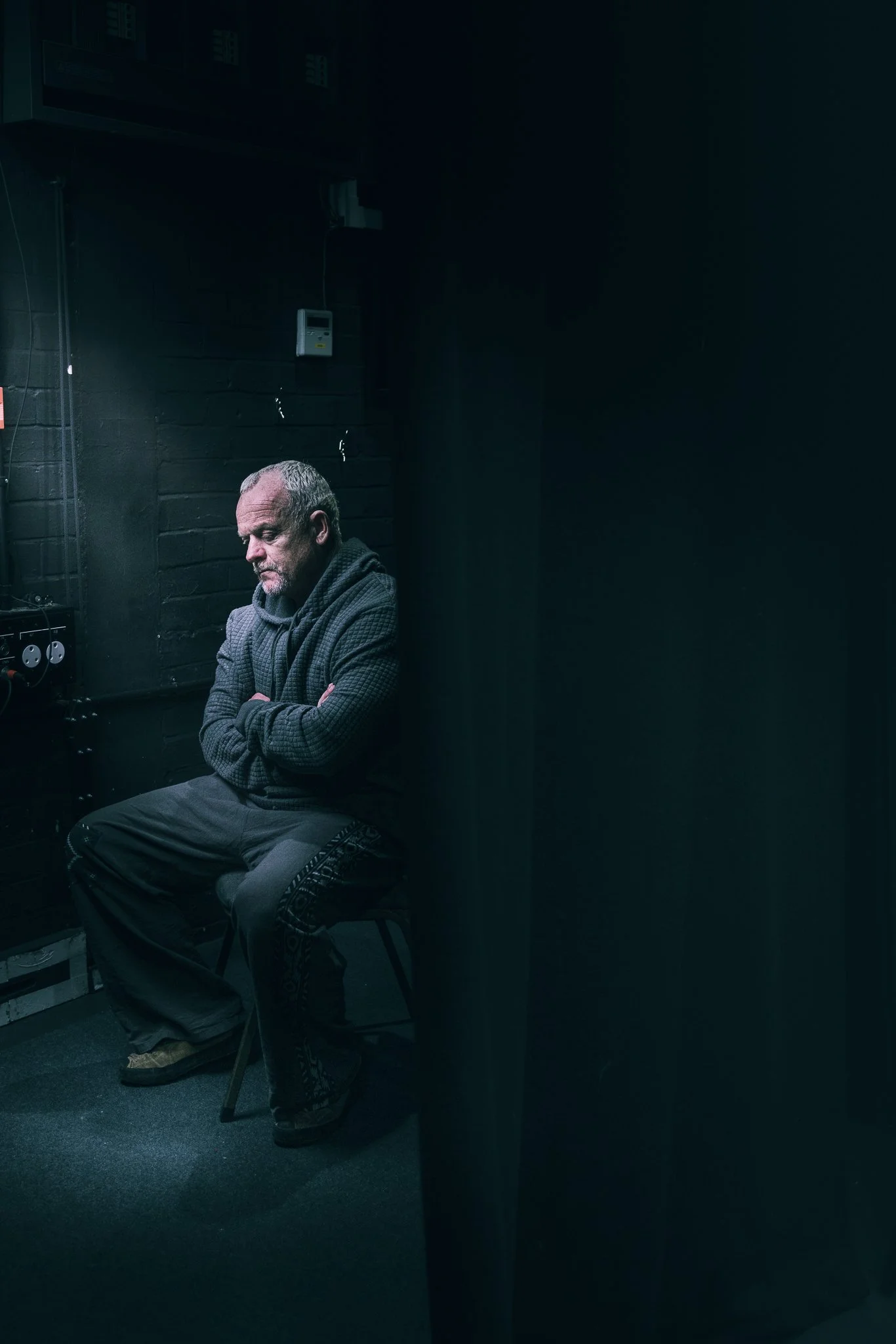
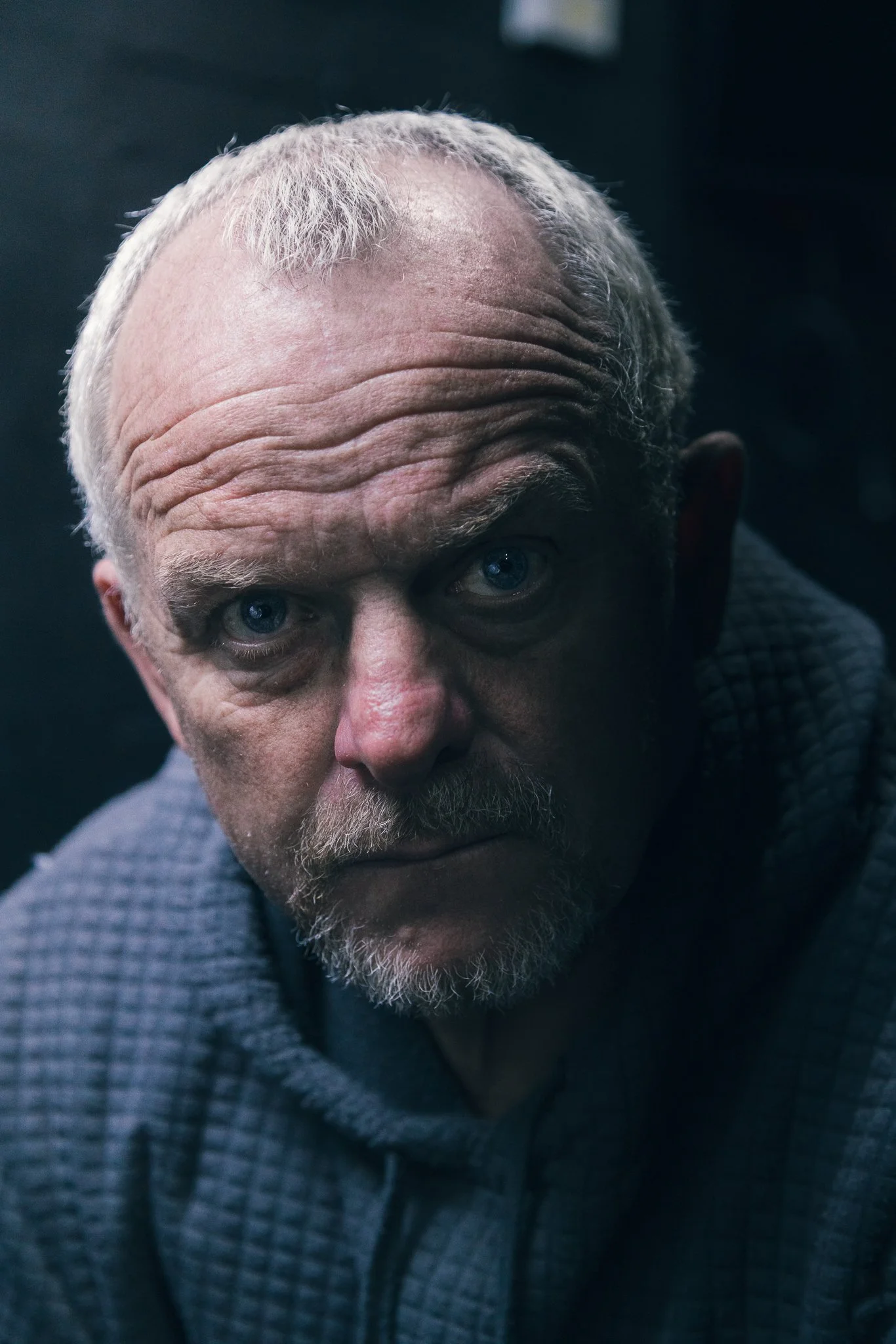
These images of Dixie, made in an Exmouth theatre feel much closer to my vision and represent the triptych vision that I initially imagined.